
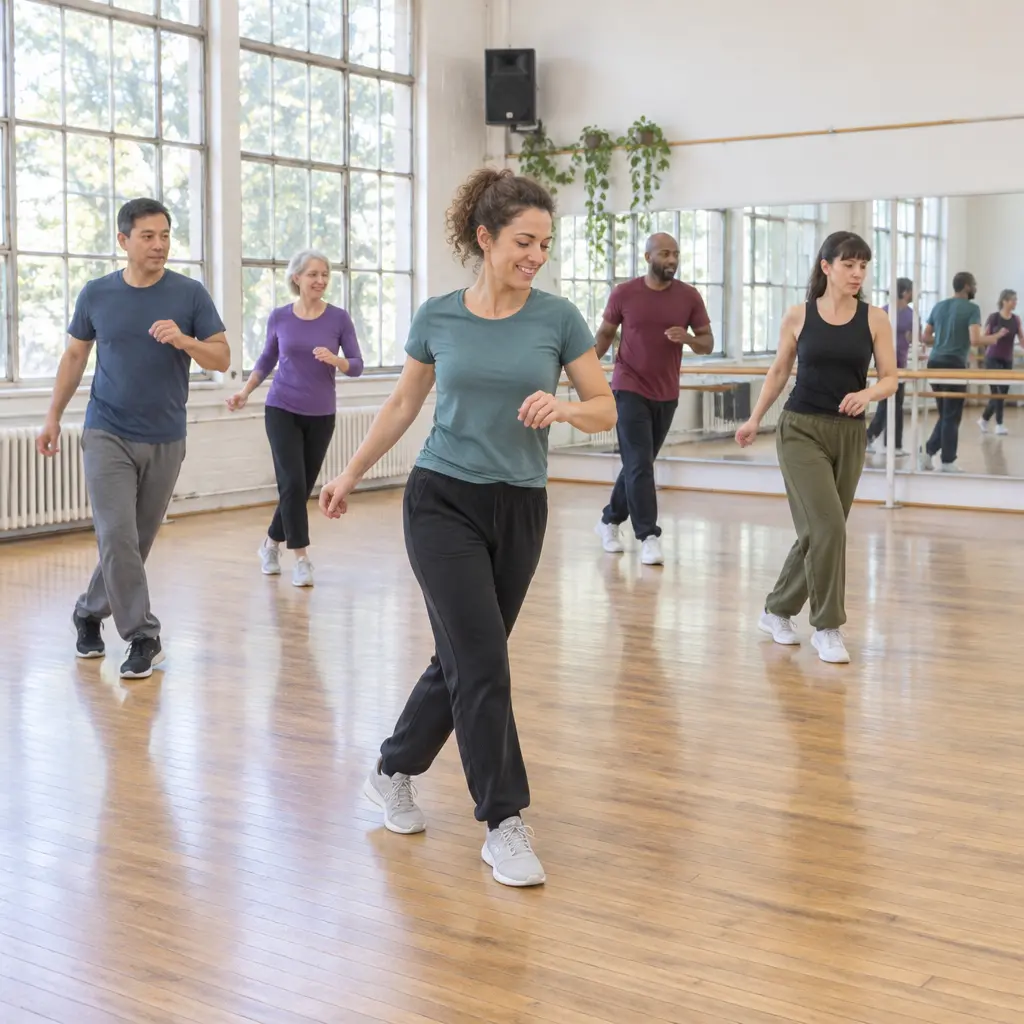
Dance is a physical activity in which people use patterned movement, often coordinated with music, to express ideas or perform socially, artistically, or competitively. How demanding it is depends on the style, pace, duration, and dancer’s experience: a gentle social dance may be light activity, while sustained ballet, tap, or fast Latin dance can challenge the heart, lungs, muscles, balance, and coordination. Research measuring professional dancers has found that rehearsals and performances can reach vigorous-intensity effort, but no single calorie or heart-rate figure applies to every dancer. Understanding dance’s intensity, physical demands, and health benefits helps people choose an appropriate style and train safely.
Dance intensity varies by style and effort
Dance intensity describes how hard the body is working during movement. The U.S. Centers for Disease Control and Prevention (CDC) classifies activity using metabolic equivalents, or METs: 1 MET approximates the energy used while resting, and moderate activity generally ranges from 3 to less than 6 METs, while vigorous activity is 6 METs or more. The 2024 Adult Compendium of Physical Activities assigns different MET values to different dance forms, reflecting that slow ballroom dancing and energetic aerobic dance do not place the same demand on the body.
Intensity also changes within a class or performance. A dancer may alternate demanding sequences with instruction, pauses, or slower sections. A useful practical check is the talk test: during moderate effort, a person can talk but not sing comfortably; during vigorous effort, speaking more than a few words at a time is difficult. These are broad guides, not substitutes for individualized medical advice.
Social and ballroom dance
Social and ballroom dance includes forms such as waltz, foxtrot, and salsa. The physical demand ranges from easy, relaxed movement to sustained, brisk dancing. Pace, footwork, partner movement, and the length of a song or session all matter. The Compendium’s activity estimates place many ballroom forms below vigorous intensity, although faster styles and continuous dancing can make a session more demanding.
Aerobic and high-tempo dance
Aerobic dance, fast hip-hop, and other high-tempo routines use repeated large-muscle movements, quick changes of direction, and sometimes jumps. These features can raise breathing and heart rate and may make the activity vigorous, particularly when performed continuously. A routine’s label alone does not determine intensity: a beginner modification can be moderate, while a fast, high-impact version may be strenuous.
Ballet, contemporary, and performance dance
Ballet and contemporary dance combine technical control with muscular strength, balance, flexibility, and repeated movement. Performance demands can vary sharply by role and choreography. In a study of professional ballet dancers, researchers measured substantial cardiovascular and metabolic demands during performance, with effort varying across roles and sections. This evidence is a reminder that a performance may include both intense bursts and lower-intensity intervals rather than one uniform workload.
Dance demands cardiovascular and muscular work
Dance’s physical load is multidimensional: it can tax the cardiovascular system, require muscular force and endurance, and challenge coordination and mobility. The American College of Sports Medicine describes cardiorespiratory fitness, muscular fitness, flexibility, and neuromotor abilities such as balance and coordination as distinct components of physical fitness. Dance can engage several of them in one session, though how much depends on the movements and training plan.
Cardiovascular endurance
Continuous dancing can increase heart rate and breathing, training the body to sustain activity. The CDC recommends that adults aim for at least 150 minutes of moderate-intensity aerobic activity per week, or 75 minutes of vigorous-intensity activity, or an equivalent combination, along with muscle-strengthening activity on two days each week. Dance can contribute to the aerobic total when its intensity and duration meet the relevant threshold. Short, gentle sessions still involve movement, but should not automatically be counted as moderate or vigorous exercise.
Strength, stamina, and power
Repeated steps and sustained positions can build muscular endurance, while jumps, lifts, and rapid changes of direction require more force and power. Dancers also rely on trunk and hip muscles to stabilize the body and control movement. Dance does not necessarily train every muscle group or replace progressive resistance exercise; people seeking balanced strength development may need additional exercises tailored to their goals.
Balance, coordination, and flexibility
Dance asks performers to coordinate steps with rhythm, spatial awareness, and sometimes a partner, while maintaining balance through turns or changes in level. Some forms also use large ranges of motion. These demands can support movement skills, but flexibility should be developed gradually rather than forced. Good technique and appropriate instruction are especially important for movements involving deep bends, pointe work, or repeated landings.
Dance benefits health, with demands that require sensible training
Dance can be an enjoyable way to accumulate physical activity, and its social and expressive features may help some people stay engaged. The World Health Organization’s physical-activity guidance emphasizes that any amount of activity is better than none and that regular activity supports health. However, demanding dance also carries physical risks, particularly when training volume rises quickly, recovery is inadequate, or technique is poor.
Health and participation benefits
Depending on intensity, dance can contribute to aerobic fitness, movement confidence, and social participation. A 2019 systematic review and meta-analysis in the British Medical Journal examined dance interventions for adults and reported benefits across several measured health outcomes, while noting that effects and evidence quality varied by study and dance program. Its findings support dance as a potentially useful activity, not a guarantee of a particular result for every person.
Injury risks and recovery
Dance injuries can involve the feet, ankles, knees, hips, or back, and may result from acute accidents or accumulated overuse. Risk depends on style, training demands, surface, footwear, technique, and individual health. The International Association for Dance Medicine & Science advises dancers to build workload progressively, warm up, maintain conditioning, and allow sufficient recovery. Persistent pain, swelling, or a sudden injury warrants evaluation by a qualified healthcare professional rather than simply pushing through.
A practical way to scale the challenge
Beginners can start with shorter sessions, slower choreography, and low-impact alternatives, then increase duration or intensity gradually. Dancers should include a warm-up, practice technique at an appropriate level, and balance demanding sessions with rest and complementary strength work. People with chronic conditions, pregnancy-related concerns, or a history of injury can ask a healthcare professional or qualified dance instructor how to adapt movement safely.
Conclusion: dance can be light activity or vigorous training
Dance is not one fixed level of exercise. Its intensity ranges from gentle social movement to vigorous performance, and its demands may include cardiovascular endurance, strength, stamina, balance, coordination, and mobility. Public-health activity targets and dance research show why it can contribute meaningfully to fitness, while variation between styles and individuals makes blanket calorie or effort claims unreliable. Choose a form that suits your goals, build up gradually, and use talk-test effort and recovery as practical guides. For more personalized guidance, consult a qualified instructor, dance-medicine professional, or healthcare provider.
Sources: Centers for Disease Control and Prevention, “Adult Activity: An Overview,” https://www.cdc.gov/physical-activity-basics/guidelines/adults.html; Ainsworth BE et al., “2024 Adult Compendium of Physical Activities: A third update of the energy costs of human activities,” Journal of Sport and Health Science, https://doi.org/10.1016/j.jshs.2023.10.010; Twitchett E et al., “The demands of a ballet performance,” Journal of Dance Medicine & Science, https://pubmed.ncbi.nlm.nih.gov/19246774/; World Health Organization, “WHO Guidelines on Physical Activity and Sedentary Behaviour,” https://www.who.int/publications/i/item/9789240015128; Merom D et al., “Effect of dancing on health and well-being of adults: a systematic review and meta-analysis,” BMJ, 2019, https://www.bmj.com/content/367/bmj.l5967; International Association for Dance Medicine & Science, “Safe Dance Practice,” https://iadms.org/education-resources/safe-dance-practice/