
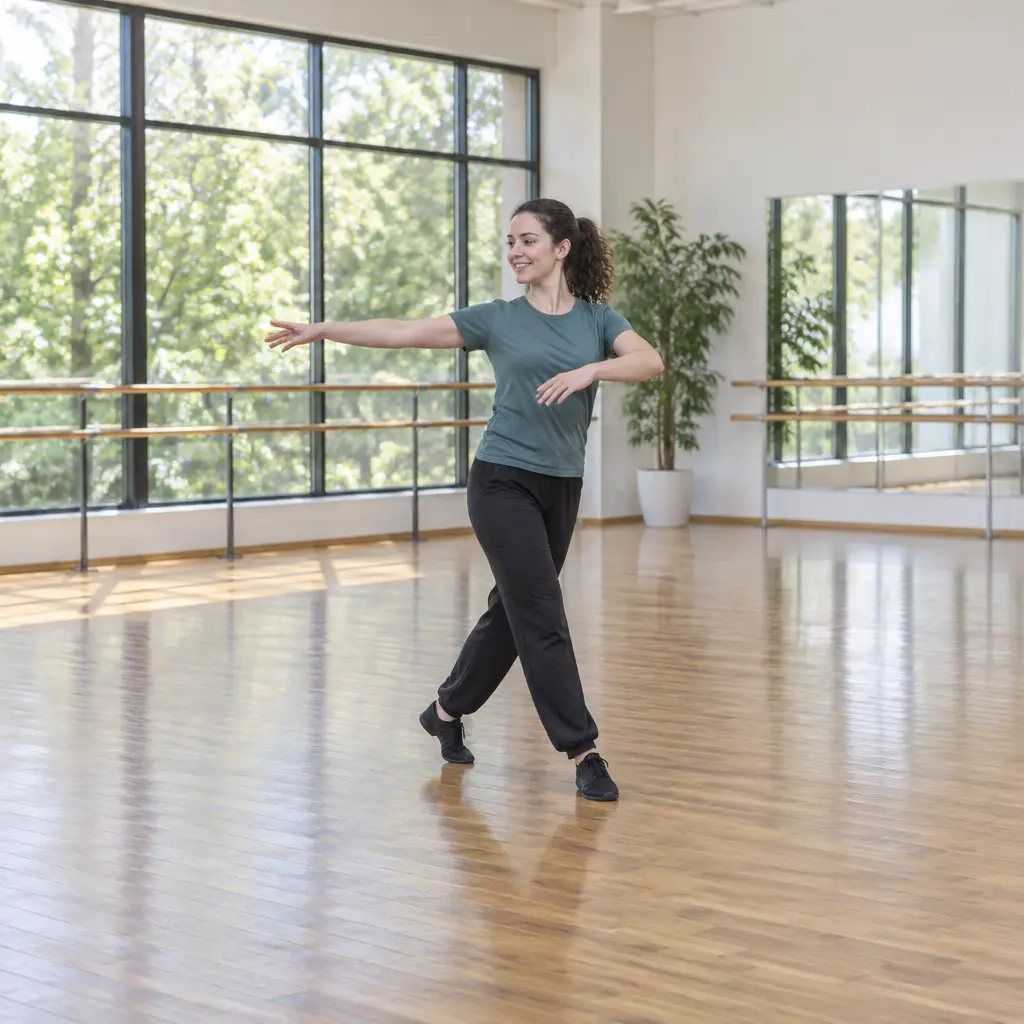
Dance coordination is the ability to organize different body parts and movement qualities in time with music, space, and other dancers. It improves through focused practice—not simply by dancing more—especially when dancers build rhythm, balance, motor control, and the ability to combine movements gradually. Research on motor learning supports practicing manageable components, receiving useful feedback, and revisiting skills over time. This guide explains how coordination works, how to train its main elements, and how to measure progress safely.
Dance Coordination: Definition and Core Attributes
Coordination in dance is the controlled timing and organization of movements to meet a task’s demands. The International Association for Dance Medicine & Science describes dance as a complex activity requiring coordination, balance, strength, flexibility, and endurance. In practical terms, coordination links a dancer’s perception of music or a cue to an accurate movement response.
The term includes several related abilities, or hyponyms: rhythmic coordination, inter-limb coordination, balance and postural control, spatial awareness, and movement sequencing. They overlap. A dancer performing a turn, for example, must maintain posture, orient in space, coordinate the arms and legs, and time the movement with the music.
Rhythmic coordination
Rhythmic coordination is the ability to perceive a beat or musical pattern and align movement with it. Dancers can develop it by clapping or stepping to a pulse before adding choreography, then practicing with varied tempos and accents. A 2022 review in Frontiers in Psychology describes music and movement as closely connected through rhythmic perception and sensorimotor synchronization; that connection helps explain why counting, listening, and moving should be practiced together.
Inter-limb coordination and movement sequencing
Inter-limb coordination means organizing the arms, legs, and trunk so they contribute to one movement rather than compete with one another. Movement sequencing is the ability to perform actions in the correct order. To train both, learn a phrase in short sections: first the foot pattern, then the arms, then the combined phrase. Once the sequence is reliable at a comfortable pace, gradually increase speed or musical complexity. This approach is consistent with motor-learning principles summarized by the U.S. National Library of Medicine’s MedlinePlus: repeated practice helps the nervous system learn and refine movement skills.
Balance, posture, and spatial awareness
Balance is the ability to maintain or regain control of the body’s position, while spatial awareness is understanding where the body is in relation to the floor, other dancers, and the direction of travel. These skills support turns, changes of level, and group formations. The Centers for Disease Control and Prevention recommends balance activities as part of physical activity for older adults; although that guidance addresses health rather than dance performance specifically, it reinforces balance as a trainable physical capacity. Dancers can work on controlled weight shifts, single-leg holds near a stable support, and clearly marked pathways.
How Practice Improves Dance Coordination
Once the components are understood, training should combine focused repetition with gradual increases in difficulty. A 2019 review in Psychological Bulletin found that distributed practice—spacing practice sessions rather than concentrating all practice into one long session—supports learning across many tasks. The exact ideal schedule varies by person and skill, but frequent, manageable sessions can make it easier to retain choreography and return to practice without excessive fatigue.
Use a slow-to-fast progression
A slow-to-fast progression means learning a movement accurately at a reduced tempo before increasing speed. Begin with counts or a metronome, then use the song at a slower playback speed if appropriate, and finally practice at performance tempo. Slow practice makes it easier to notice timing errors, unclear transitions, or unnecessary tension. Increase only one challenge at a time—for example, speed, arm complexity, direction, or travel—so the movement remains controlled.
Break choreography into chunks
Chunking divides a long phrase into smaller, memorable units. Practice each unit, connect neighboring units, and then rehearse the full phrase. Labeling a transition with a simple cue—such as “step, turn, reach”—can also help recall. When a section becomes consistent, change the starting point or practice it without the teacher’s demonstration to check whether the sequence has been learned rather than merely copied visually.
Coordinate the body through layered practice
Layered practice adds body parts or performance demands in stages. A dancer might first learn a lower-body rhythm, add arm pathways, then include head direction and expressive dynamics. This reduces the number of new demands introduced at once. A 2018 consensus statement from the National Strength and Conditioning Association emphasizes that training should be specific to the desired movement and adjusted to the participant’s ability; for dancers, that means progressing from simple combinations toward the actual coordination demands of their style.
Use feedback without becoming dependent on it
Feedback helps identify the difference between intended and actual movement. Useful options include a teacher’s concise cue, a mirror used briefly, or a video recording reviewed after the attempt. Focus on one correction at a time, such as landing quietly or arriving on the beat. Then repeat without watching the mirror or replaying the video. This encourages self-assessment, which is important when performing in a space without external visual feedback.
A Practical Coordination Routine for Dancers
A short routine can combine rhythm, sequencing, balance, and spatial control. Adapt the movements to your dance style, training level, and any advice from a qualified teacher or clinician. Stop if you experience sharp pain, dizziness, or unusual symptoms.
- Warm up with easy walking, gentle joint movement, and low-intensity steps.
- Clap, tap, or step a steady beat, then repeat with different accents or tempos.
- Practice a short foot pattern slowly, adding the arms only after the feet are clear.
- Work on controlled weight shifts and simple balance holds near a stable support.
- Travel along a clear pathway, changing direction while keeping awareness of the room.
- Perform a short phrase with music, then identify one specific point to improve.
A simple progress chart can track tempo, phrase length, accuracy, and perceived effort. For example, record whether a phrase was completed correctly at a slow, moderate, or performance tempo, rather than judging progress only by how difficult the session felt. Avoid treating this as a standardized test: it is a personal monitoring tool, not a clinical measurement.
Common Coordination Problems and Safe Adjustments
Rushing or losing the beat
Rushing often occurs when a dancer tries to remember steps and follow the music at the same time. Return to a clear pulse by counting aloud, marking the beat with a small movement, or practicing the phrase without music before adding it back. If the tempo is too demanding, reduce it temporarily and restore the original tempo in small steps.
Arms and legs feel disconnected
When limbs seem difficult to coordinate, simplify the phrase instead of repeating the full version with growing frustration. Practice the arms and legs separately, then combine them at a slower speed. Check whether the difficulty comes from unclear timing, an unfamiliar direction, or too many simultaneous instructions; each calls for a different adjustment.
Tension, fatigue, or inconsistent balance
Excess tension and fatigue can interfere with precise control. Take a brief rest, reduce repetitions, and make sure the practice area is clear and the floor is appropriate for the dance style. The International Association for Dance Medicine & Science advises dancers to attend to conditioning, recovery, and injury prevention as parts of training. Persistent pain or recurring balance problems warrant assessment by a qualified health professional rather than simply pushing through.
Conclusion: Build Coordination One Layer at a Time
Dance coordination brings together rhythm, limb timing, movement sequencing, balance, and spatial awareness. Improve it by breaking skills into manageable sections, practicing accurately at a slower tempo, adding complexity gradually, and using feedback to guide—not replace—your own attention. Track small, observable changes and allow time for rest and repetition. Choose one coordination goal for your next practice, such as staying with the beat or making an arm-and-leg pattern clearer, and build from there.
Sources: International Association for Dance Medicine & Science, “The Dancer as Athlete,” https://iadms.org/resources/; Frontiers in Psychology, “The Neurosciences and Music: A Review of the Literature,” https://www.frontiersin.org/journals/psychology; MedlinePlus, “Motor Skills,” https://medlineplus.gov/ency/article/002368.htm; Centers for Disease Control and Prevention, “Older Adult Activity: An Overview,” https://www.cdc.gov/physical-activity-basics/guidelines/older-adults.html; Psychological Bulletin, “A Review of the Distributed Practice Effect: Now You See It, Now You Don’t,” https://doi.org/10.1037/bul0000162; National Strength and Conditioning Association, “Progression Models in Resistance Training for Healthy Adults,” https://doi.org/10.1249/MSS.0b013e3181915670.