
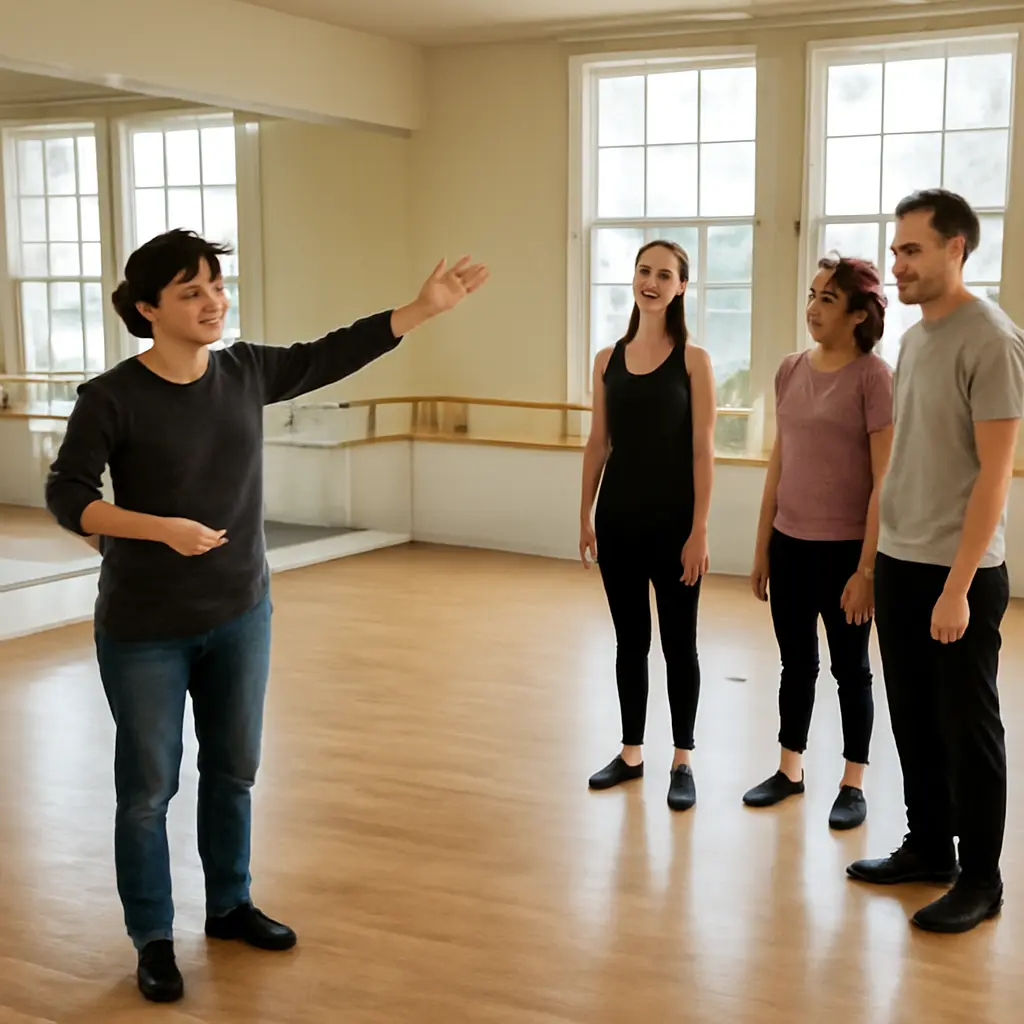
Dance creates meaning through movement, timing, space, facial expression, and relationships between performers—without requiring spoken language. In dance studies, these choices are often understood as choreography and embodied communication: the body can suggest emotion, identity, conflict, or community, though interpretation depends on cultural context and the viewer. Research on gesture and emotion, UNESCO’s recognition of dance traditions as intangible cultural heritage, and examples ranging from ballet pantomime to hip-hop show how movement carries both personal and shared meaning. This article explains the basic idea, identifies the movement tools dancers use, considers how culture and audiences shape interpretation, and offers practical ways to watch dance closely.
Dance communicates meaning through embodied movement
“Nonverbal communication” is the communication of information and feeling through channels other than spoken or written words. In dance, these channels include posture, gesture, facial expression, rhythm, spatial arrangement, and interaction. Dance scholar Susan Leigh Foster’s work on choreography treats movement as something that can organize bodies and make ideas perceptible; it is not simply a decorative addition to a verbal message.
A dance does not, however, function as a universal dictionary. A raised hand might signal invitation, authority, grief, or a culturally specific gesture, depending on its form and setting. Meaning emerges from the movement itself, the music or silence around it, the conventions of a dance tradition, and what audiences bring to the performance. This makes dance both expressive and interpretive: performers shape possible meanings, while spectators make sense of them.
The topic matters because dance can communicate across differences in spoken language while also preserving meanings that are specific to a community. UNESCO’s 2003 Convention for the Safeguarding of the Intangible Cultural Heritage recognizes practices such as dance as living heritage transmitted through communities. Its framework emphasizes that heritage is continually recreated, rather than frozen in a single historical form.
Movement communicates through gesture, energy, and space
A dancer’s movement vocabulary is the set of physical actions and stylistic choices used in a performance. It can include recognizable gestures, steps, poses, and patterns of motion, as well as qualities such as tension, weight, speed, and flow. Choreographers combine these elements so that a movement can carry emotional force, point toward an idea, or change meaning as it recurs.
Gesture and facial expression suggest intention
Gesture is a movement that appears to carry expressive or communicative purpose, such as reaching, pointing, shielding, or offering. Facial expression can support that gesture, complicate it, or deliberately contrast with it. For instance, an outstretched arm may read as a plea when paired with a searching gaze, but as a command when the torso is upright and the gaze is steady.
Psychologist Paul Ekman’s research on facial expression helped establish a widely influential account of recognizable emotional expressions, while later scholarship has emphasized that emotion is also shaped by context and culture. Dance makes this complexity visible: a performer may exaggerate, withhold, or stylize expression, so spectators should consider the whole body and scene rather than treating one facial cue as a definitive translation.
Body shape, force, and timing create emotional texture
The shape and effort of a movement can suggest a quality of feeling without naming an emotion. A contraction may appear protective or inward; a sudden expansion may suggest release or defiance. Light, sustained movement often feels different from heavy, sharply accented movement, even when both use the same pathway through space. In dance analysis, these qualities are sometimes discussed through effort, dynamics, or movement quality.
Timing also changes interpretation. A pause can create suspense, make a gesture seem consequential, or invite attention to a relationship. Repetition may imply insistence, ritual, labor, or memory; a break in a repeated pattern can signal disruption. These are possibilities, not fixed rules: the same choreographic choice can work differently depending on the dance style, music, and performance context.
Space and relationships show power and belonging
Choreographic space includes a dancer’s personal kinesphere, the stage area, pathways, levels, and the distances between performers. A soloist placed at the center may appear prominent, while a performer at the edge may seem isolated or excluded. A group moving in unison can suggest solidarity, discipline, or collective identity; a dancer moving against the group may appear resistant or alone.
These effects are particularly clear in ensemble works, where formations and changes in proximity make social relationships visible. In a duet, for example, a repeated approach-and-retreat pattern can suggest attraction, mistrust, or negotiation. The audience reads these patterns as part of the dance’s nonverbal structure, even when the choreography provides no explicit plot.
Dance traditions shape how movement is understood
Dance genres are not merely different collections of steps; they carry conventions that help performers and audiences interpret movement. Ballet, social dance, hip-hop, and ritual dance can use similar physical actions but frame them differently. Knowing a tradition’s history and performance setting can therefore make a viewer more attentive to meanings that might otherwise be missed.
Ballet uses stylized gesture and theatrical convention
Classical ballet often combines codified technique with theatrical gesture and narrative staging. In story ballets, gestures, mime, costumes, and recurring musical themes can help establish character or action. A gesture should not automatically be treated as a universal sign, however: its meaning may depend on the particular production and its historical conventions.
Ballet also communicates without a plot. In abstract choreography, line, balance, rhythm, and the arrangement of bodies may invite an emotional or formal response rather than tell a literal story. The distinction shows that meaning in dance can be narrative, atmospheric, symbolic, or focused on movement itself.
Hip-hop and social dance communicate identity and community
Hip-hop dance developed within a broader cultural movement associated with Black and Latino communities in the United States, especially New York City in the 1970s. Styles such as breaking, popping, and locking use distinct movement vocabularies, improvisation, musical responsiveness, and forms of personal style. In a battle, a dancer’s movement can function as a challenge, a display of skill, or a response to an opponent, while the audience and community help shape the event’s meaning.
Social dances also preserve and circulate shared practices. The Smithsonian’s National Museum of African American History and Culture documents the importance of African American cultural expression to the development of hip-hop. Learning a move’s name or origin can deepen appreciation, but respectful interpretation also requires recognizing the communities and histories from which styles emerged.
Ritual and heritage dances carry community knowledge
In ritual and heritage contexts, dance may connect movement with ceremony, spiritual practice, seasonal events, or collective memory. Its meaning can depend on who performs it, when it is performed, and what knowledge is shared within the community. UNESCO’s Intangible Cultural Heritage framework highlights the role of communities in identifying and safeguarding such practices.
This context matters when dances move onto commercial or international stages. A performance can increase visibility, but presentation outside its original setting may alter how viewers understand it. Where possible, audiences should consult community-led explanations and avoid assuming that a dance’s full significance can be inferred from movement alone.
Music, silence, and audience interpretation complete the message
Dance often communicates through the relationship between movement and sound. A dancer may follow a beat, resist it, echo a musical phrase, or move against the expected rhythm. Silence can make breathing, footfalls, and small shifts in weight more noticeable, directing attention toward the body and the space around it.
Audience interpretation is an active part of the experience. Viewers notice patterns, connect gestures to prior experience, and revise their impressions as the choreography develops. A useful way to watch is to ask what changes: Who moves first? Who follows? What is repeated? Where does the group look? What happens when the music changes or stops? These questions encourage observation without insisting on one correct reading.
A simple comparison can show how context shifts meaning: a tightly synchronized group might suggest celebration in one performance and conformity in another. The movement is similar, but costumes, music, staging, cultural conventions, and the surrounding narrative influence what it communicates. If this comparison were displayed as a chart, its columns could list movement choice, performance context, and possible audience interpretations—clearly marking interpretations as possibilities rather than facts.
Conclusion: dance creates meaning through shared attention
Dancers create meaning without words by shaping gesture, facial expression, body dynamics, timing, space, and relationships. Dance traditions provide conventions and histories that inform those choices, while music, silence, and audience experience influence how they are received. Because movement does not have one universal translation, attentive interpretation combines close observation with respect for cultural context.
Dance is therefore more than a visual performance: it can express emotion, communicate identity, build community, and carry living heritage. To explore further, watch a performance more than once, compare how movement changes across styles, and seek explanations from artists and communities connected to the tradition.
Sources: UNESCO, Convention for the Safeguarding of the Intangible Cultural Heritage, 2003, https://ich.unesco.org/en/convention; UNESCO, What Is Intangible Cultural Heritage?, https://ich.unesco.org/en/what-is-intangible-heritage-00003; Foster, Susan Leigh, Choreographing Empathy: Kinesthesia in Performance, Routledge, 2011, https://www.routledge.com/Choreographing-Empathy-Kinesthesia-in-Performance/Foster/p/book/9780415775500; Ekman, Paul, “An Argument for Basic Emotions,” Cognition and Emotion, 1992, https://doi.org/10.1080/02699939208411068; Smithsonian National Museum of African American History and Culture, A New African American Identity: The Harlem Renaissance, https://nmaahc.si.edu/explore/stories/new-african-american-identity-harlem-renaissance.