
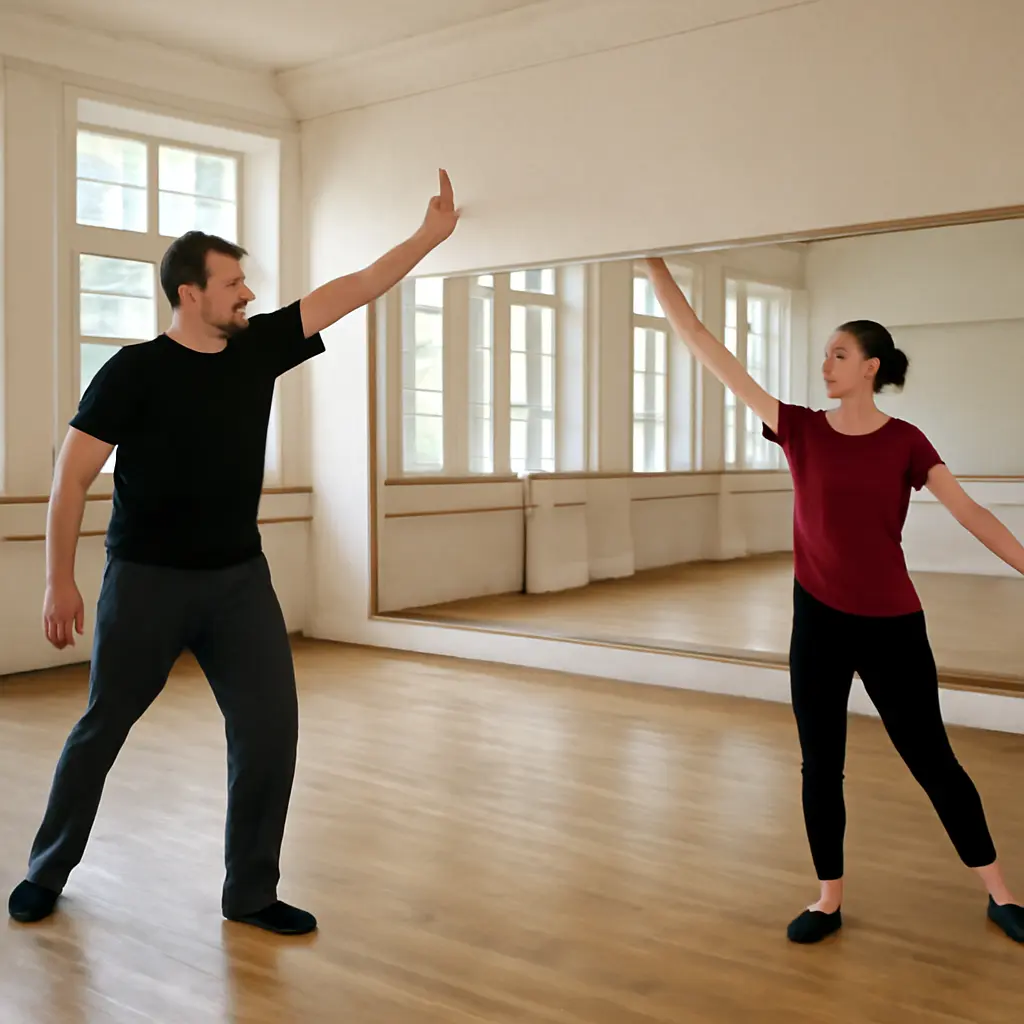
Contemporary dance and modern dance are related but distinct forms of concert dance. Modern dance emerged in the late 19th and early 20th centuries as a departure from ballet’s formal conventions, while contemporary dance developed later and draws on modern dance, ballet, and other movement traditions. The clearest difference is that modern dance refers to a historically rooted set of movements and approaches, whereas contemporary dance is a broad, evolving practice shaped by current choreographic ideas. Their histories, techniques, performance styles, and influential artists help explain why the terms are often confused—and why they are not interchangeable.
Modern Dance: A Historically Defined Attribute of Concert Dance
Modern dance is a concert-dance tradition that took shape in the United States and Europe around the turn of the 20th century. The Library of Congress describes modern dance as a form that arose partly in reaction to classical ballet, with choreographers seeking greater freedom of movement and more personal expression. Rather than following one universal technique, modern dance encompasses distinct schools and methods developed by influential artists.
Its defining historical context is important: modern dance was once the “new” alternative to ballet, but it is now an established tradition with a century of repertory, training practices, and institutional history. The National Endowment for the Arts’ arts-participation research tracks dance as a major category of arts engagement, though it does not treat modern and contemporary dance as separate, directly comparable statistical categories. As a result, stylistic distinctions are best explained through history and movement practice rather than a single audience or participation statistic.
Origins and artistic purpose
Modern dance developed as artists challenged ballet’s emphasis on pointe work, turnout, and codified positions. Early innovators such as Isadora Duncan favored more natural, expressive movement; later pioneers developed distinct approaches that could address social, psychological, or abstract themes. The term “modern” therefore describes a historical movement and its artistic break with convention, not simply any dance created recently.
Modern-dance techniques and movement principles
Modern-dance training may emphasize weight, gravity, breath, contraction and release, floor work, and movement initiated from the torso. These features vary by technique. Martha Graham’s method, for example, is associated with contraction and release; José Limón’s approach gives particular attention to weight, fall, and recovery. Such methods are influential examples, not requirements that every modern-dance work must follow.
Modern-dance examples and legacy
Martha Graham’s company and repertory demonstrate how modern dance established recognizable choreographic lineages and training systems. The Martha Graham Dance Company, founded in 1926, is among the longest-running dance companies in the United States. Its continued performance of Graham’s works shows how a form that began as a challenge to convention became a preserved and evolving artistic heritage.
Contemporary Dance: A Broad, Evolving Attribute of Current Performance
Contemporary dance is a broad category of dance made and performed in the present era, often combining ideas from modern dance, ballet, improvisation, and other movement practices. Unlike modern dance, it does not name one historical school or a single codified technique. The term is used differently across countries, companies, schools, and artists, so a contemporary work may look very different from another work described by the same label.
Contemporary dance’s openness is a defining characteristic. Choreographers may blend established techniques with pedestrian movement, spoken text, digital media, or forms drawn from other dance traditions. The result is not necessarily a rejection of technique; rather, technique is selected and adapted to serve the work’s artistic purpose.
Contemporary-dance technique and hybridity
Contemporary training commonly draws on multiple movement vocabularies. A dancer might use ballet alignment and extension, modern-dance floor work, release-based movement, improvisation, or partnering within a single performance. Because the field is hybrid, no one movement feature—such as floor work or bare feet—can reliably define every contemporary dance piece.
Improvisation, collaboration, and experimentation
Improvisation is the creation of movement in the moment, either as a rehearsal tool or as part of a live performance. Contemporary choreographers may use improvisation to generate material, structure interactions, or let performers make choices during a work. Collaboration with musicians, designers, filmmakers, and visual artists is also common, although it is not exclusive to contemporary dance.
Contemporary-dance examples and current practice
Choreographers such as Crystal Pite illustrate the range of contemporary practice, moving between narrative, abstraction, ensemble choreography, and theatrical design. Her work for companies including Nederlands Dans Theater shows how contemporary dance can draw on highly trained ballet dancers while using movement and staging that do not fit neatly into classical ballet or a single modern-dance method.
How Modern Dance and Contemporary Dance Differ
The difference is primarily historical and conceptual, not a simple contrast between two sets of steps. Modern dance points to a particular artistic movement and its descendant techniques. Contemporary dance describes a wider, current field that may include modern-dance influences alongside many other sources.
-
Historical meaning: Modern dance developed as a break from ballet conventions in the late 19th and early 20th centuries. Contemporary dance refers broadly to present-day choreographic practice.
-
Technique: Modern dance may be associated with identifiable methods such as Graham or Limón. Contemporary dance is generally less unified and may combine several techniques.
-
Movement vocabulary: Modern dance often foregrounds expressive use of weight, breath, gravity, and the torso. Contemporary dance can include these qualities but may also incorporate ballet, improvisation, pedestrian movement, and other vocabularies.
-
Relationship to tradition: Modern dance has a defined historical lineage. Contemporary dance can engage with, reinterpret, or depart from that lineage.
-
Meaning of the label: “Modern” is not a synonym for “recent.” A modern-dance work can be decades old, while contemporary dance usually signals work connected to current artistic practice.
A useful way to picture the relationship is as overlapping circles: contemporary dance often inherits modern-dance ideas, but it is not limited to them. A performance may combine a modern technique with ballet-based partnering and improvisation, making its classification depend on the choreographer’s context and the work’s artistic framework.
Why the Distinction Matters for Dancers and Audiences
For dancers, the distinction can guide training choices. Someone studying modern dance may focus on a particular technique and its history, while contemporary training often calls for adaptability across movement styles and creative processes. For audiences, recognizing the difference helps place a work in context: its movement may reflect a historical lineage, a current experiment, or both.
The categories are not rigid boxes. Dance companies and educational programs use the terms in varied ways, and artists may resist labels altogether. When a program calls a performance “contemporary,” the most reliable guide is often its description of the choreographer, movement sources, and artistic aims rather than the label alone.
Conclusion: Modern Dance and Contemporary Dance as Distinct but Connected Practices
Modern dance is a historically defined tradition that challenged ballet’s conventions and developed influential techniques and repertories. Contemporary dance is a wider, evolving field that may draw from modern dance, ballet, improvisation, and other practices. Their overlap explains why the terms are sometimes used interchangeably, but their different histories and scopes make the distinction useful for studying, teaching, performing, and viewing dance.
To explore the difference further, compare a work by a modern-dance pioneer with a recent contemporary performance, and pay attention to movement sources, choreographic choices, and historical context. Seeing the forms side by side is often the clearest way to understand both their shared vocabulary and their distinct artistic identities.
Sources: Library of Congress, “Modern Dance,” https://www.loc.gov/item/ihas.200156436/; National Endowment for the Arts, Survey of Public Participation in the Arts, https://www.arts.gov/impact/research/publications/survey-public-participation-arts; Martha Graham Dance Company, “About,” https://marthagraham.org/about/; Nederlands Dans Theater, “Crystal Pite,” https://www.ndt.nl/en/choreographers/crystal-pite/