
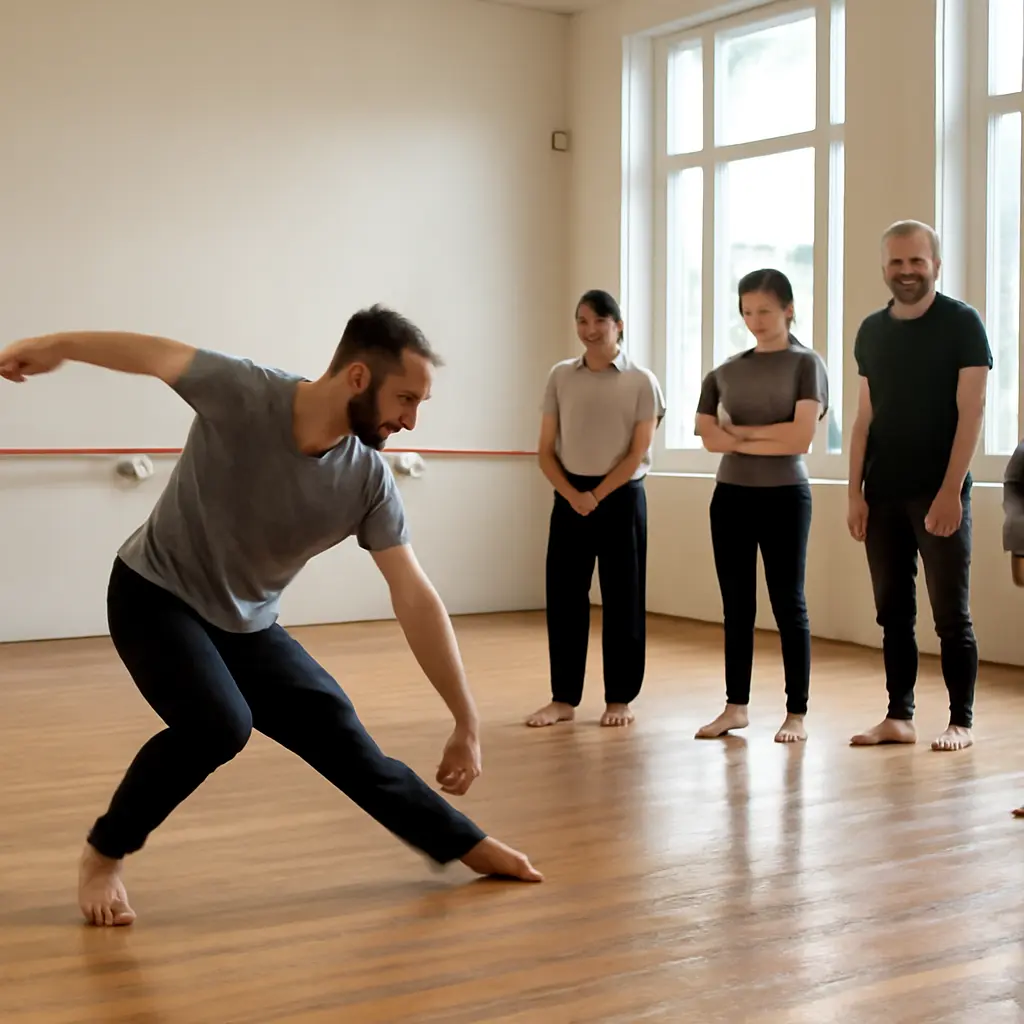
Contemporary dance is a broad, evolving approach to concert dance that draws on modern dance, ballet, improvisation, and other movement traditions. There is no single technique or universally accepted definition: choreographers and performers combine methods to explore movement, space, music, and ideas in distinct ways. This guide explains the form’s history and defining attributes, introduces major styles and techniques, and considers how choreography, performance, training, and access shape contemporary dance today. Its reach is reflected in the U.S. Bureau of Labor Statistics’ estimate of about bailar? 26,500 jobs for dancers and choreographers in 2023, although that figure covers many dance genres rather than contemporary dance alone.
Contemporary Dance History and Defining Attributes
Contemporary dance is best understood as a changing field of practice rather than a fixed vocabulary of steps. The U.S. National Endowment for the Arts describes dance broadly as an art form that uses the human body in rhythmic movement, while institutions such as the Royal Academy of Dance distinguish contemporary dance through its openness to multiple techniques and its emphasis on individual expression. In practice, the term commonly refers to concert dance developed from the mid-20th century onward, though artists use it in different ways.
The form matters because it gives choreographers tools to examine identity, politics, emotion, and social relationships through the body. Its defining attributes often include grounded movement, shifts between tension and release, use of gravity, varied dynamics, and experimentation with space and time. These are tendencies, not rules: a work may be highly structured, improvised, physically athletic, quiet, or deliberately resistant to conventional beauty and narrative.
Historical Roots and Evolution
Contemporary dance developed through overlapping histories rather than a single origin. Early modern dance artists—including Isadora Duncan, Martha Graham, and Doris Humphrey—challenged the formal conventions of classical ballet and developed new movement approaches. In the later 20th century, postmodern choreographers questioned the idea that dance had to tell a story, use trained virtuosity, or be accompanied by music. Contemporary practice continues to absorb influences from ballet, modern dance, street and social dance, martial arts, somatic practices, and performance art.
This history explains why contemporary dance can look dramatically different from one production to another. A company may draw on Graham-based contraction and release, while another may use pedestrian gestures, task-based movement, or improvisation. The Smithsonian’s National Museum of American History documents the development of modern dance as a significant American cultural tradition, while dance archives and performance institutions preserve the varied lineages that inform current work.
Movement Qualities and Physical Principles
Common movement principles include weight-sharing, floor work, off-balance actions, changes in level, and an awareness of breath and momentum. “Grounded” movement uses the floor as an active partner rather than treating the body as continuously lifted. “Release” techniques encourage dancers to reduce unnecessary muscular effort and let gravity, alignment, and momentum support movement. These principles can improve expressive range, but they require careful instruction and body awareness.
Contemporary technique is not synonymous with unrestricted movement. Dancers still develop strength, coordination, alignment, spatial awareness, and the ability to repeat complex material. The difference is that training may value adaptable problem-solving as much as mastery of a standardized sequence.
Contemporary Dance Styles and Techniques
Because contemporary dance incorporates multiple lineages, its styles are often identified by their methods, choreographic aims, or training systems. The categories below overlap, and a single performance can combine several of them. Understanding these connections helps audiences recognize how a work’s movement choices contribute to its meaning.
Modern Dance Techniques
Modern dance techniques are structured training approaches developed by influential artists and teachers. Martha Graham technique, for example, emphasizes contraction and release, while José Limón’s approach is associated with fall and recovery and the expressive use of weight. Merce Cunningham developed a distinct approach to movement and choreography, often separating dance from musical structure. These techniques are not interchangeable, but each offers dancers a vocabulary for control, dynamics, and expression.
Contemporary companies may teach a specific technique or combine several approaches. A dancer’s training can therefore include ballet for alignment and precision, modern technique for weight and dynamics, and improvisation for responsiveness. The exact combination varies by school, company, and choreographer.
Improvisation and Contact Improvisation
Improvisation is the creation of movement in real time, guided by tasks, images, musical cues, or interactions with other dancers. Contact improvisation, initiated by Steve Paxton in 1972, explores shared weight, touch, balance, and momentum between partners. Practitioners often use rolling, leaning, and counterbalance to discover movement rather than reproduce a fixed sequence.
Improvisation can serve as performance, rehearsal research, or a way to generate choreography. It relies on attention and consent, especially when touch and weight-sharing are involved. Clear boundaries and communication make partnering safer and more artistically responsive.
Ballet, Contemporary Ballet, and Fusion
Contemporary ballet combines aspects of classical ballet training with newer movement ideas, including grounded weight, unusual torso articulation, and nontraditional music or staging. The term is sometimes used interchangeably with ballet-influenced contemporary dance, but companies and critics may draw distinctions. The shared feature is a dialogue between ballet’s formal training and a wider range of movement choices.
Fusion also occurs across cultural and popular forms. Choreographers may work with hip-hop, folk, social, or club-dance vocabularies, but responsible practice requires understanding the histories and communities connected to those forms. Contemporary dance is most compelling when borrowing is thoughtful and credited, rather than treating culturally specific movement as a decorative effect.
Contemporary Dance Choreography and Performance
Choreography shapes movement into a work through choices about bodies, timing, space, repetition, sound, and audience attention. A contemporary dance piece may use a clear narrative, an abstract structure, or a combination of both. Its meaning can emerge not only from steps but also from relationships, pauses, lighting, costume, and the physical presence of performers.
Choreographic Methods and Collaboration
Choreographers create material through set movement, improvisation, research, and collaboration with dancers. Some establish every detail; others provide tasks and shape the dancers’ responses. Collaborative processes may also involve composers, designers, dramaturgs, and community participants. The result can be a tightly scored work or a performance that changes from night to night.
A practical example is a rehearsal process in which dancers improvise around a theme, the choreographer selects recurring gestures, and the group arranges them into a score. Repetition gives the work structure, while variations in timing or intensity preserve a sense of live discovery.
Music, Sound, Space, and Technology
Contemporary dance can be performed with composed music, recorded sound, spoken text, silence, or sounds produced by the dancers themselves. Choreography may follow musical phrasing, work in counterpoint with it, or treat sound as one element among many. Stage design and lighting can likewise direct attention, alter a performer’s apparent scale, or make the audience aware of the performance space.
Technology has expanded these possibilities through projection, digital sound, motion capture, and online performance. These tools do not automatically make a work contemporary; their value depends on how they contribute to the choreography and the audience’s experience.
Notable Companies and Real-World Examples
Companies such as Alvin Ailey American Dance Theater, Nederlands Dans Theater, and the Martha Graham Dance Company illustrate the breadth of concert dance traditions associated with contemporary performance. Their repertories and artistic histories differ: Ailey’s work is strongly connected to African American cultural experience, Nederlands Dans Theater is known for commissioning a wide range of choreographic voices, and the Graham company preserves and develops a modern dance lineage.
These examples show why contemporary dance should not be reduced to one visual style. Audiences can compare how different companies use ensemble movement, gesture, music, and theatrical design to create distinct artistic identities.
Contemporary Dance Training, Careers, and Access
Training and professional practice connect the artistic ideas of contemporary dance to the physical and economic realities of a dancer’s life. The field includes performers, choreographers, teachers, rehearsal directors, and production professionals. Access to training and performance opportunities, however, varies by geography, cost, disability access, and the resources available to arts organizations.
Training and Injury Prevention
Training commonly develops strength, flexibility, coordination, musicality, and the ability to learn movement quickly. Warm-ups, progressive conditioning, rest, and attention to pain are important because dance places repeated physical demands on the body. The International Association for Dance Medicine & Science provides educational resources on dancer health and injury prevention, emphasizing that conditioning and recovery should be part of training rather than afterthoughts.
New dancers can begin with open classes, community programs, or introductory courses. A qualified instructor can adapt exercises to different experience levels and discuss safe approaches to floor work, partnering, and impact. Anyone experiencing persistent pain should seek advice from an appropriate health professional.
Employment and the Dance Economy
The U.S. Bureau of Labor Statistics reported approximately 26,500 jobs for dancers and choreographers in 2023 and projects employment in those occupations to grow 5 percent from 2023 to 2033. These figures cover dance across genres and do not isolate contemporary dance. The BLS also notes that many dancers work part time or have periods without work, making teaching, freelance projects, and multiple contracts common parts of a career.
For artists and audiences alike, this context underscores the importance of fair pay, sustainable rehearsal schedules, accessible venues, and stable support for arts organizations. Public funding, philanthropy, ticket sales, and educational programs all contribute to the conditions under which dance can be made and seen.
Inclusion and Accessible Practice
Inclusive contemporary dance challenges assumptions about which bodies can perform and what virtuosity looks like. Disability arts organizations and integrated companies demonstrate that choreography can be created around diverse movement practices, assistive devices, and different modes of communication. Accessibility can also include captioning, audio description, relaxed performances, step-free access, and clear information for audiences before they attend.
These approaches are not simply accommodations added after a work is complete. When access is considered from the beginning, it can influence movement, staging, rehearsal methods, and the relationship between performers and audiences.
How to Watch and Explore Contemporary Dance
There is no single correct way to interpret a contemporary dance performance. Viewers can begin by noticing changes in energy, repeated gestures, relationships between dancers, and how sound or space shapes attention. Reading a program note may provide context, but direct observation is equally valuable.
A Practical Viewing Checklist
- Notice how the dancers use weight, balance, gravity, and the floor.
- Watch for repeated movement, sudden changes, and moments of stillness.
- Consider whether the movement follows the music, contrasts with it, or occurs in silence.
- Observe how performers relate to one another and to the audience.
- Afterward, reflect on what stayed with you rather than searching for one “correct” meaning.
To explore further, attend performances by different companies, take an introductory class, or consult archives and educational resources from reputable dance institutions. Comparing varied works is the clearest way to experience the form’s range.
Conclusion: Why Contemporary Dance Matters
Contemporary dance is an evolving field shaped by modern dance histories, varied techniques, improvisation, choreography, and cultural exchange. Its physical principles create a wide movement vocabulary, while its performance practices allow artists to respond to personal, social, and artistic questions. Training, employment conditions, and accessibility also influence who gets to make dance and who can experience it.
The employment figures from the Bureau of Labor Statistics offer a useful view of dance work in the United States, but they cannot capture the full cultural value of performance or distinguish contemporary dance from other genres. To understand the form, watch broadly, learn about the artists and traditions behind the work, and support accessible, fairly resourced dance communities.
Sources: U.S. Bureau of Labor Statistics, Dancers and Choreographers, https://www.bls.gov/ooh/entertainment-and-sports/dancers-and-choreographers.htm; National Endowment for the Arts, Dance, https://www.arts.gov/impact/research/arts-data-profile-series/adp-10; Royal Academy of Dance, Contemporary Dance, https://www.royalacademyofdance.org/dance-classes/contemporary/; Smithsonian National Museum of American History, Dance: The History of Modern Dance, https://americanhistory.si.edu/collections/object-groups/dance; International Association for Dance Medicine & Science, Resources, https://iadms.org/resources/; Alvin Ailey American Dance Theater, About Us, https://www.alvinailey.org/about; Nederlands Dans Theater, About NDT, https://www.ndt.nl/en/about-ndt/; Martha Graham Dance Company, About, https://marthagraham.org/about/; Contact Quarterly, Contact Improvisation: A Brief History, https://contactquarterly.com/contact-improvisation/.