
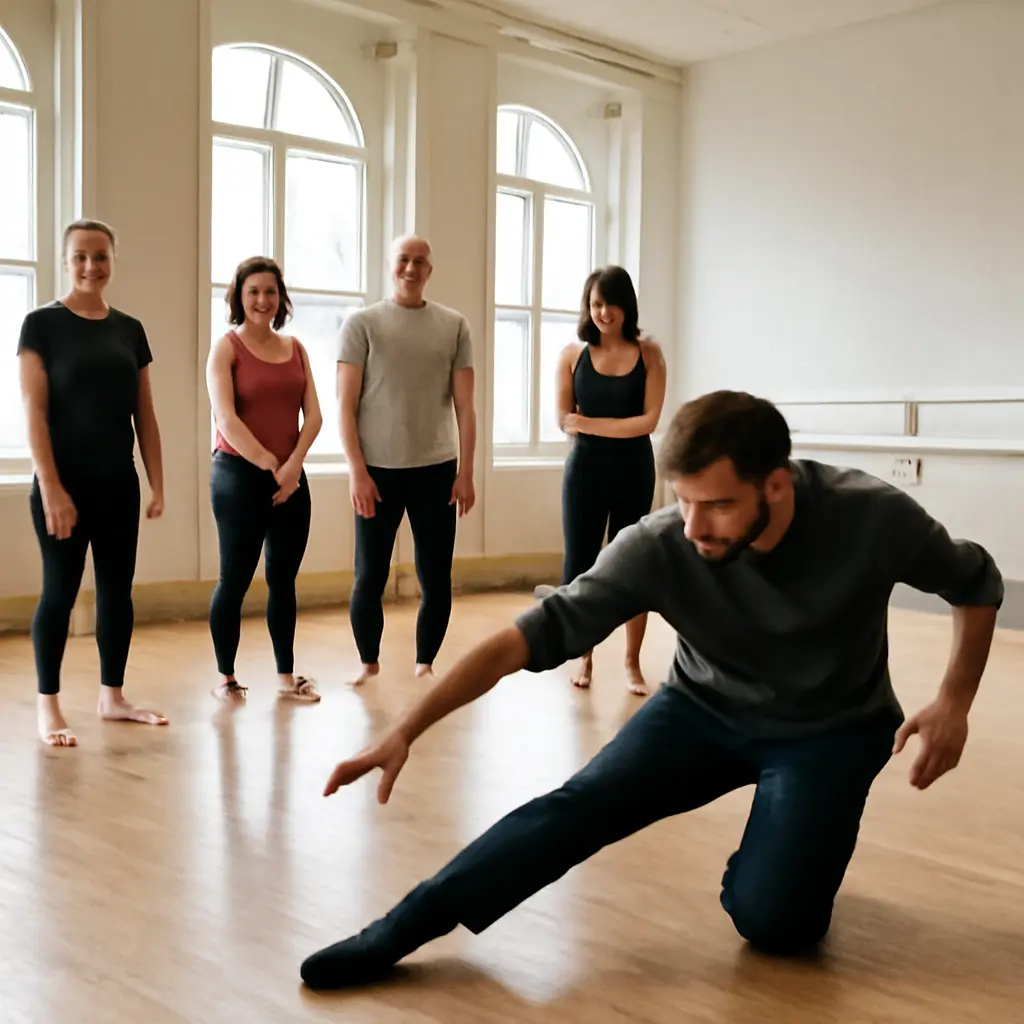
Modern dance is a broad family of concert-dance practices that developed in the late 19th and early 20th centuries as artists sought alternatives to ballet’s conventions. Its central ideas are that movement can express personal and social experience, that the whole body can be a source of choreography, and that dance can question inherited rules. These ideas appear in modern dance’s emphasis on individual expression, experimentation with technique and space, and engagement with cultural and historical change. The Smithsonian American Art Museum describes modern dance as a movement away from ballet’s formal constraints, while the National Museum of American History’s collection documents how its pioneers developed new movement vocabularies.
Modern Dance Defines Movement as Personal Expression
Modern dance is not one fixed technique or style. Dance scholar and critic John Martin helped popularize the term in the United States, describing modern dance as an art in which movement could communicate inner experience. In contrast to a single codified vocabulary, modern dance includes distinct approaches created by artists such as Isadora Duncan, Martha Graham, Doris Humphrey, and Merce Cunningham. Their work differs in form, but shares a willingness to treat the dancer’s body and choices as sources of artistic meaning.
This focus on expression connects modern dance to its historical challenge to convention: if movement can come from lived experience, then artists can reconsider not only how a dance looks, but also whose experience is represented and what subjects dance can address.
Individual Experience and Emotion
Individual expression means that a dancer’s movement may convey emotion, memory, or a personal response rather than simply display a prescribed ideal. Isadora Duncan, for example, rejected pointe shoes and the rigid posture associated with classical ballet. She performed barefoot in loose garments and drew inspiration from natural gestures, ancient art, and music. Her choices made the body’s weight, breath, and flow part of the performance’s meaning.
Expression does not mean that modern dance lacks craft. Duncan’s example shows instead that technique can be developed in service of an artistic idea. The Smithsonian American Art Museum’s account of modern dance places this rejection of ballet’s conventions within a broader search for new forms of movement and expression.
Movement as a Dramatic Language
Modern dancers often use movement to suggest conflict, relationships, or states of mind without relying on spoken dialogue or a literal plot. Martha Graham’s choreography, for instance, used contraction and release—alternating muscular gathering with expansion—as a distinctive movement principle. Graham’s technique linked physical action to psychological intensity, giving the torso a central role in communicating dramatic force.
This expressive approach broadened the subjects dance could explore. A work could investigate grief, identity, myth, or social tension through gesture, rhythm, and spatial relationships, rather than merely retell a story through pantomime.
Modern Dance Expands Technique Through Experiment
Modern-dance technique refers to the trained use of the body, including balance, alignment, breath, strength, rhythm, and movement through space. Unlike ballet, modern dance has no single worldwide vocabulary or universally required syllabus. Artists and schools have developed different systems, some of which became influential training methods in their own right.
The variety of techniques reflects a larger principle: movement is not limited to elevation, symmetry, or outward display. Modern dance draws on gravity, weight, the floor, and the body’s capacity to change direction and shape. These technical experiments also created pathways for later artists to question whether choreography must follow music, narrative, or established steps.
Gravity, Breath, and the Floor
Many modern-dance approaches treat gravity as a creative partner rather than a force to overcome. Dancers may bend, fall, roll, recover, or shift weight close to the floor. Doris Humphrey developed the principle of “fall and recovery,” exploring the balance between yielding to gravity and regaining stability. This approach makes momentum and vulnerability visible while requiring precise control.
Breath is similarly practical and expressive: it supports effort and can shape the timing and intensity of movement. The emphasis on breath, weight, and floorwork contrasts with the lightness often associated with ballet, but it does not remove discipline. It redirects training toward different physical possibilities.
Improvisation and New Movement Choices
Improvisation is the creation of movement in the moment, often within a task, score, or set of limits. It helps dancers discover unfamiliar gestures and gives choreographers ways to build material beyond a fixed list of steps. Improvisation can be spontaneous, but it can also involve close attention to timing, space, partner relationships, and movement quality.
Merce Cunningham extended experimentation by separating dance from the assumption that it must illustrate the music. In some collaborations, choreography and music were created independently and brought together in performance. This practice made coincidence, attention, and the audience’s interpretation part of the experience, and it helped broaden the range of structures available to choreographers.
Modern Dance Challenges Tradition and Engages Society
Modern dance’s challenge to tradition is both aesthetic and social. Its pioneers questioned inherited standards of posture, costume, movement, and theatrical presentation. Later artists also used choreography to examine race, gender, politics, and community. This history is not a single story of progress: modern dance developed through artists with different backgrounds, and access to training, stages, and recognition has not been equal.
The field’s changing ideas about who dances and what dance can say connect its formal experiments to wider cultural debates. Examples from the early modern era and later repertory show how breaking with convention can involve new movement forms as well as new perspectives.
A Break from Ballet’s Conventions
Modern dance emerged partly in reaction to ballet’s established techniques and theatrical expectations. Artists explored barefoot performance, naturalistic or angular gestures, everyday movement, and costumes that allowed different kinds of motion. These choices were not simply visual novelties; they signaled that dance could be built from principles other than the pursuit of an idealized, weightless body.
The Smithsonian American Art Museum presents modern dance as a distinct movement shaped by artists’ efforts to move beyond ballet’s rules. The result was not the disappearance of ballet, but the expansion of concert dance into multiple artistic traditions, each with its own aims and methods.
Cultural Identity and Social Commentary
Modern dance has also served as a way to represent cultural identity and respond to public life. African American choreographer and anthropologist Katherine Dunham drew on Caribbean and African-diasporic movement traditions in her work, combining performance with research and cultural study. Her influence illustrates that modern dance’s innovations did not come from a single source or a single community.
Other choreographers have used dance to address historical memory, social injustice, and collective experience. Such works show how movement can carry meanings shaped by culture and history, while also reminding audiences that interpretations may differ. The National Museum of African American History and Culture and the National Museum of American History provide collections and historical context for understanding the artists and traditions that have shaped American dance.
Modern Dance Influences Contemporary Performance
Modern dance remains relevant because its defining questions continue to shape choreography: What can movement communicate? Which bodies and traditions belong onstage? Must dance follow music or narrative? Contemporary dance often blends modern-dance techniques with ballet, improvisation, theater, street forms, and digital media. The boundaries among these categories are porous, so “modern dance” is best understood as a historical movement and an ongoing influence rather than a single present-day style.
A useful way to see that influence is through repertory and training. A Graham-based contraction, a Humphrey-style fall and recovery, or Cunningham’s use of chance may appear in works that do not identify themselves solely as modern dance. These examples demonstrate how artistic ideas can outlast the original movement that introduced them.
Training, Repertory, and Preservation
Dance companies, schools, archives, and museums help preserve modern-dance repertory and its historical context. Reconstructing a work can involve studying notation, film, photographs, oral histories, and the memories of dancers who performed it. Preservation is challenging because dance exists primarily in the moving body; recordings can document a performance but cannot fully replace the experience of live movement or the knowledge passed between dancers.
The Library of Congress and major museum collections preserve dance-related materials that help researchers trace performance histories. These resources make it possible to study not only celebrated choreography but also the conditions, collaborations, and cultural exchanges that shaped it.
A Practical Lens for Watching Modern Dance
Viewers can approach modern dance by noticing how performers use weight, breath, space, rhythm, and stillness. Instead of asking only what a dance “means,” consider how its movement creates meaning: Does a dancer resist gravity or yield to it? Does the choreography follow the music, counter it, or ignore it? How do costume, lighting, and relationships among performers shape the work?
These questions connect the audience to modern dance’s core ideas without requiring prior technical knowledge. They also encourage further exploration through live performances, artist biographies, museum collections, and dance-history resources.
Conclusion: Modern Dance Makes Movement a Site of Discovery
The main ideas behind modern dance are personal expression, experimentation with the body and movement, resistance to inherited conventions, and engagement with cultural and social experience. Its pioneers developed distinct techniques—from Duncan’s expressive natural movement to Graham’s contraction and release, Humphrey’s fall and recovery, and Cunningham’s separation of dance and music—rather than one universal method. Their influence continues in contemporary performance, training, and repertory.
Understanding modern dance matters because it reveals how artistic form can change when people question established rules and broaden who gets to create, perform, and interpret dance. To explore further, watch a live performance, compare works by different choreographers, and consult museum and library collections to learn how movement traditions develop over time.
Sources: Smithsonian American Art Museum, “Modern Dance,” https://americanart.si.edu/; National Museum of American History, “Dance,” https://americanhistory.si.edu/; National Museum of African American History and Culture, “Katherine Dunham,” https://nmaahc.si.edu/; Library of Congress, “Dance,” https://www.loc.gov/collections/; John Martin, The Modern Dance, A. S. Barnes and Company, 1933.