
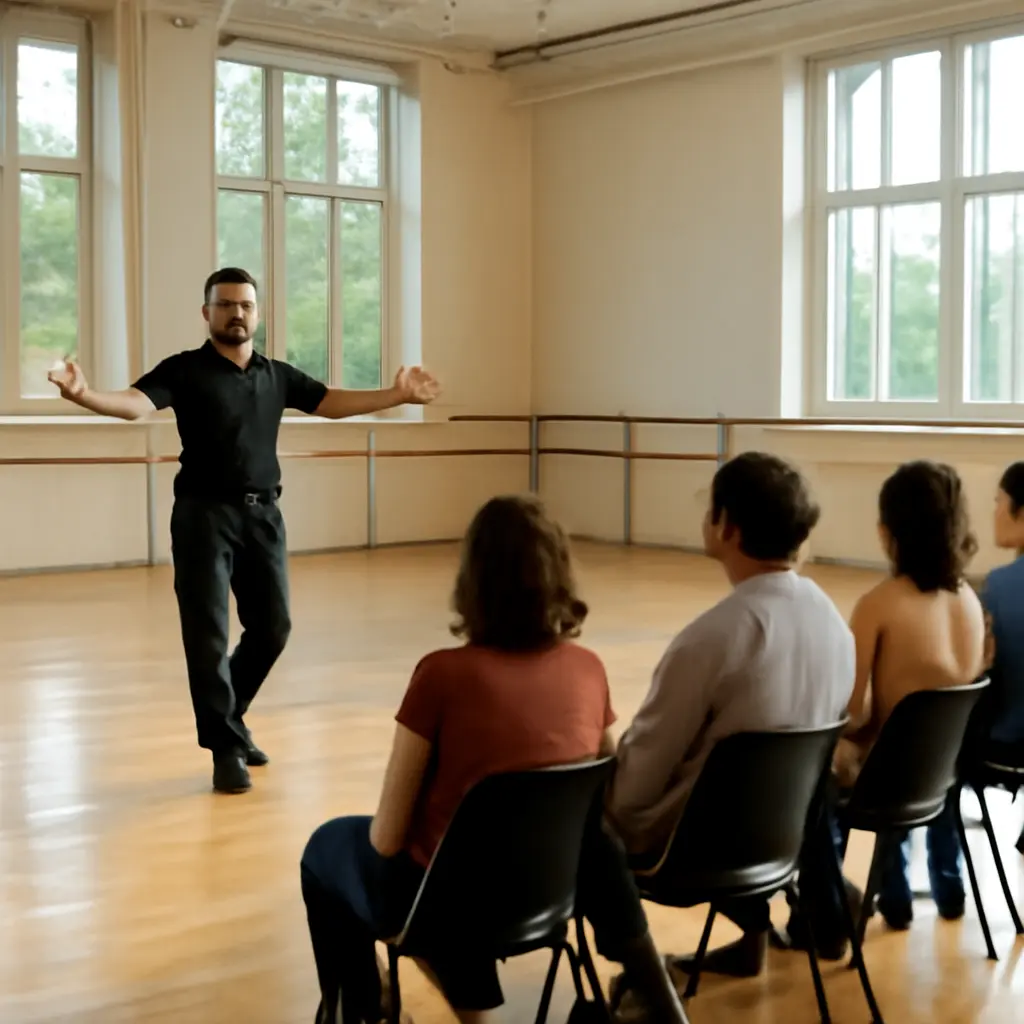
A dancer who stops hiding makes a private experience visible through movement, and the audience’s response can turn that act into a moment of recognition, connection, or debate. In dance, “stopping hiding” may mean revealing a face or body, moving beyond a role designed to conceal, or performing with greater emotional openness. The response is not guaranteed applause: research on live performance suggests that audiences attend to both movement and one another, while studies of dance and emotion show that viewers can make meaningful judgments from movement alone. Understanding this exchange means looking at embodied expression, audience perception, cultural context, and the limits of what a performance can claim to reveal.
Dance visibility and audience response
“Hiding” is not a formal dance-science term with one agreed definition. Here, it describes performance choices that restrict or obscure a dancer’s visibility or self-expression—such as masks, veils, turned-away gestures, tightly controlled movement, or an emotionally guarded style. Stopping hiding is therefore best understood as a change in performance: the dancer makes more of their face, movement, identity, or feeling available to the viewer.
That change matters because dance communicates through bodies in motion, not only through plot or spoken explanation. In a 2006 study published in Proceedings of the National Academy of Sciences, Beatrice de Gelder and colleagues found that observers could recognize emotional information in point-light displays of body movement, even when the performers’ bodies were reduced to moving dots. The finding supports a careful claim: visible movement can convey emotional cues, but it does not allow viewers to know a dancer’s private thoughts with certainty.
Exposure, revelation, and expressive visibility
Exposure means becoming more visible; revelation means that the performance invites an interpretation of what that visibility signifies. A dancer removing a mask, facing the audience, or expanding a previously restrained gesture may signal vulnerability, defiance, confidence, or simply a choreographic transition. The meaning depends on the work’s setting, movement vocabulary, costume, lighting, and cultural references.
The distinction is important: an audience can observe a physical change, but it cannot automatically verify a biographical story about the performer. A visible gesture may be personal, fictional, symbolic, or all three. Strong interpretation therefore considers the choreography and context rather than treating a dancer’s body as transparent evidence of their inner life.
Hyponyms: ways a dancer may stop hiding
Several more specific forms sit beneath the broader idea of becoming visible. They include facial revelation, where a mask or veil is removed; spatial revelation, where a dancer turns toward the audience or enters the center of the stage; kinetic revelation, where restrained movement becomes expansive; and identity-centered performance, where a work foregrounds aspects of a performer’s lived or community identity. These are related but not interchangeable: a change in costume does not necessarily mean emotional disclosure, and expressive movement does not necessarily reveal personal identity.
The audience response likewise has several forms: attention, emotional engagement, recognition, discomfort, applause, silence, or discussion after the performance. These responses can coexist. A quiet audience may be absorbed rather than indifferent, while applause may reflect appreciation without indicating agreement with a work’s message.
Audience response to a dancer’s visibility
Audience response is the collection of perceptions and behaviors that arise as viewers encounter a performance. It includes immediate reactions in the room and later interpretation. The National Endowment for the Arts’ 2022 Survey of Public Participation in the Arts reported that 8.2 percent of U.S. adults attended a dance performance in person during the preceding year. The figure describes participation, not how viewers reacted, but it underscores that live dance remains a measurable part of cultural life.
A dancer’s increased visibility can redirect attention: viewers may follow a face, a gesture, or a relationship between performer and audience that was previously obscured. In a live setting, this attention is social as well as individual. In “The Social Life of the Theater,” published in American Journal of Sociology in 2000, theater researchers Richard A. Peterson, Pamela C. Hull, and Roger M. Kern examined how audience members’ conduct and shared setting shape the experience of performance. Their work offers a useful frame for dance: audience response happens in a room where people can notice one another, not in isolation.
Recognition and emotional engagement
Recognition occurs when viewers connect a movement, image, or theme with something they know—an emotion, relationship, social experience, or cultural reference. Emotional engagement may appear as focused attention, laughter, tears, stillness, or a later conversation. These reactions are evidence of audience experience, not proof that every viewer understood the work in the same way.
Research on embodied perception helps explain why movement can feel legible. De Gelder and colleagues’ point-light experiments showed that observers can identify emotional qualities from bodily motion even without ordinary visual detail. For choreography, this suggests that a dancer’s shift from contracted, guarded movement to open, sustained movement may be perceived as a meaningful contrast. The interpretation remains shaped by the viewer’s experience and by the performance’s artistic choices.
Silence, discomfort, and mixed reactions
A response need not be visibly positive to be significant. Silence can indicate concentration, uncertainty, reverence, or disengagement; discomfort may arise when a work challenges expectations about bodies, gender, disability, race, intimacy, or who is allowed to occupy the stage. Because the same response can have different causes, choreographers and presenters should avoid treating applause volume as a complete measure of impact.
A more useful evaluation combines observation with audience feedback. Post-show conversations, anonymous surveys, accessible discussion formats, and responses from community partners can help distinguish a deliberate artistic challenge from confusion caused by unclear framing or inaccessible presentation. Such methods do not remove disagreement; they make it easier to understand what viewers experienced and why.
Context, consent, and representation
Visibility is never only an individual choice when performance is shaped by institutions, audiences, and cultural histories. The decision to reveal a face, body, or identity may be empowering for one dancer and unsafe or unwanted for another. Costuming, choreography, publicity, photography, and audience access can all affect who controls the meaning and circulation of a performance.
The World Health Organization’s 2019 report on arts and health reviewed evidence from more than 3,000 studies across varied artistic activities. It describes ways the arts can support health and well-being, while also emphasizing that outcomes depend on the activity and context. This broad evidence does not establish that a particular dance performance will be therapeutic. It does support taking artistic participation seriously while avoiding promises that exposure or emotional openness will benefit every performer or viewer.
Agency and the choice not to reveal
Agency means that the dancer has meaningful control over how they are represented and what they disclose. A performer should not be expected to remove a mask, narrate personal hardship, or embody a community’s experience merely to make a work seem authentic. Concealment can itself be an artistic strategy, a cultural practice, a boundary, or a source of power.
Practical safeguards include clear agreements about recording and photography, informed consent for promotional materials, accessible dressing and rehearsal spaces, and opportunities for performers to discuss how identity is framed. These measures matter especially when a work draws on personal testimony or involves dancers whose bodies have historically been scrutinized or misrepresented.
A real-world example: audience participation in dance
Immersive and participatory dance makes the audience’s role especially visible. In these formats, viewers may move through a performance space, choose where to look, or interact with performers. The form can create a stronger sense of proximity, but proximity is not the same as consent: audience members need clear information about whether participation is optional, and dancers need agreed boundaries for interaction.
A useful case-study approach is to compare audience accounts with the choreographer’s stated intentions and the dancers’ own reflections. For instance, a production that transitions from masked movement to direct eye contact could invite viewers to describe what changed in their attention, while performers explain whether the transition felt exposing, liberating, theatrical, or simply technically necessary. This comparison avoids reducing the work to a single audience reaction.
How to interpret the moment without overclaiming
When a dancer stops hiding, the audience may witness a choreographic turning point—but the significance is made through movement, context, and reception together. A careful reading separates what can be observed from what is inferred: the dancer turns forward, removes a covering, or expands a gesture; viewers respond in varied ways; the performance’s wider meaning remains open to interpretation.
- Describe the visible change before assigning it a meaning.
- Consider the work’s cultural, historical, and theatrical context.
- Recognize that audience reactions vary and may be difficult to read from the room alone.
- Respect the performer’s right to disclose, withhold, or complicate personal meaning.
- Use audience feedback and performer reflection when evaluating impact.
Conclusion: visibility becomes a shared event
A dancer’s decision to become more visible can shift attention and invite recognition, emotional engagement, discomfort, or debate. Research on movement perception supports the idea that viewers read emotional information from bodily action, while audience studies remind us that responses are shaped by the live social setting. At the same time, visibility does not make a performer’s inner life fully knowable, and no single reaction defines a performance’s success.
The broader implication is that powerful dance depends not only on revelation but also on agency, context, and attentive spectatorship. Viewers can respond thoughtfully by describing what they saw, listening to perspectives beyond their own, and avoiding assumptions about what a dancer must feel. For further reading, explore the National Endowment for the Arts’ participation research, studies of embodied emotion, and the World Health Organization’s review of arts and health.
Sources: Beatrice de Gelder, Jean-Michel Vroomen, Stephen Annen, and Edward J. A. J. de Haan, “The perception of emotion in body expressions,” Proceedings of the National Academy of Sciences, 2006, https://www.pnas.org/doi/10.1073/pnas.0606877103; National Endowment for the Arts, 2022 Survey of Public Participation in the Arts, https://www.arts.gov/impact/research/publications/2022-survey-public-participation-arts; Richard A. Peterson, Pamela C. Hull, and Roger M. Kern, “The Social Life of the Theater,” American Journal of Sociology, 2000, https://doi.org/10.1086/210350; World Health Organization, What is the evidence on the role of the arts in improving health and well-being? A scoping review, 2019, https://www.who.int/europe/publications/i/item/9789289054553